01
What to Wear to Weekend Brunch Without Looking Overdressed
How to build a brunch look around one favorite piece, proportion, layering and enough ease to continue through the rest of the day.
Leer artículo
A seven-piece capsule can cover travel, city, resort and dinner when each garment has more than one function.
A seven-piece capsule is not meant to reduce travel to a formula. It demonstrates something more useful: when every garment has more than one function, the wardrobe can stay small without feeling limited. In warm weather—where a day moves between airport, street, resort, beach and interiors—that flexibility matters more than packing a separate look for every occasion.
The logic of El Viaje begins with that ability to repeat, layer and move pieces across contexts.
Seven pieces are not a universal rule for every journey. The number is a tool for understanding what becomes possible when garments share colors, proportions and practical functions. Trip duration, opportunities to wash clothing and the expectations of visited venues may change the necessary number completely. A capsule works when it is built around a specific person and actual activities rather than demonstrating that a holiday can be reduced to an arbitrary count.
A capsule works best when it answers a real itinerary. Think transit, day, lunch, beach, interiors and dinner. Then choose pieces that can cover two or three of those moments.
They should work as a base across several days. With a shirt they can feel more precise; with a tunic or layer they can relax.
Pantalón San Cristóbal can fill that role.
A shirt can be worn closed, open, with sleeves rolled or as a second layer. That multiplies combinations without adding another garment.
Before choosing a garment, describe the most common day of the journey: how much walking is likely, where meals will take place, whether beach activities or indoor settings are involved and which transport will be used. Identify the occasion requiring the most considered level of dress. With that outline, pieces can be chosen for overlapping needs. Three complete looks that share no base may make little sense when two can be resolved by changing a layer or shoes. A capsule reduces decisions because the relationships between garments have been considered in advance.
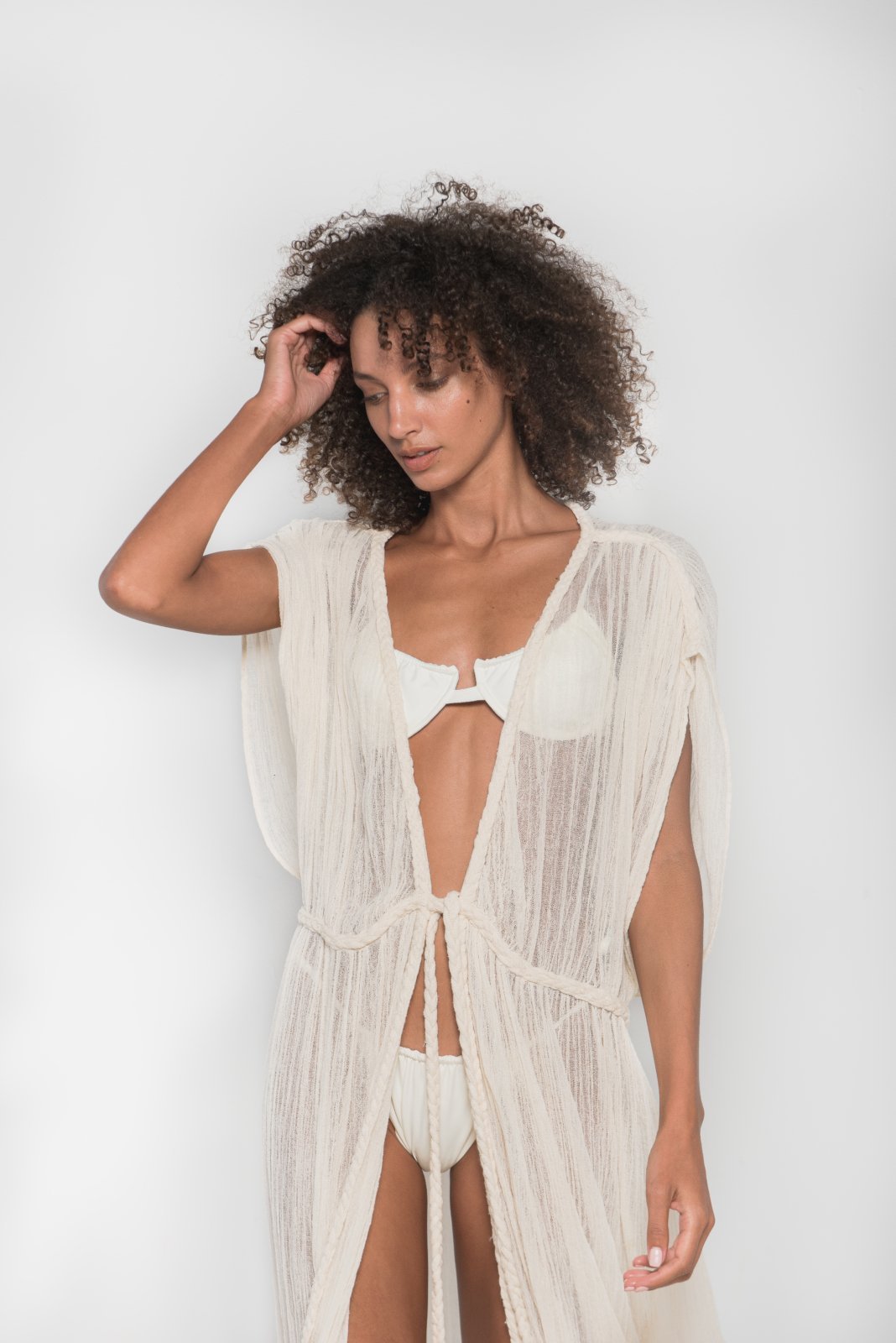
The kimono adds length and movement. It can work in wind, interiors or as a statement at night.
Kimono Tao is a clear example of that versatile layer.
The ruana occupies a different role because its open construction can feel more enveloping than a kimono.
Trousers that work with several shirts and one complete dress or tunic can establish a useful base. The active San Cristóbal trousers and Joaquina tunic provide examples of different functions, but sizing and care still need checking. A capsule does not demand neutral colors. A personal palette containing stronger shades can remain coherent when the actual combinations work. Test garments with the shoes intended for the journey rather than trusting how each item looks in isolation.
A complete silhouette reduces decisions and can move between day and night through layering.
The tunic sits between dress, layer and long top. Túnica Joaquina can work near the sea, at resort or over trousers.
An outer layer serves a different purpose from a base garment: it may help in a cool interior or change the outfit's outline. But it also occupies luggage space. Packing several similar layers offers little advantage when none combines with the central pieces. A focal garment earns its place when it can be worn in more than one realistic setting instead of one hypothetical dinner. Consider folded volume and care requirements. Something that appears light on the body is not always compact or effortless to transport, especially if its finishing requires protection.
Color, embroidery, texture or a recognizable shape break visual repetition. It does not need to match everything; it needs to work with enough of the capsule to justify its place.
The goal is not to avoid repeating. It is to make repetition look different through layer, footwear and proportion.
Read What to Pack for a Warm-Weather Trip and What to Wear from Airport to Resort.
A well-edited suitcase does not have fewer possibilities. It has fewer wasted pieces.
Once the pieces are assembled, build actual combinations and count those that work without additional purchases. Walk, sit and check proportions. Consider whether the clothing could also be worn after returning home; a capsule designed entirely around a destination photograph may offer less value than expected. For the journey's beginning, read what to wear from airport to resort. The usefulness of seven pieces is not demonstrated by the number itself but by their ability to accompany different situations comfortably and coherently.
Pantalón San Cristóbal · Kimono Tao · Túnica Joaquina
What to Wear at a Beach Resort · What Makes a Garment Timeless?
It depends on duration and activities; here seven works as a practical exercise in versatility.
The bases and layers: trousers, shirts, kimonos and tunics usually offer the most combinations.
Change proportion, layer and footwear before adding more garments.
A.03 / JOURNAL / SELECTION
Pieces that continue this story.
New editions, pieces, places, craft and ways of living.